
A few nights ago, I found myself having one of those conversations that begins with comic books and ends somewhere entirely unexpected.
We were discussing Grant Morrison's Supergods, a remarkable book that explores why superheroes have remained culturally relevant for nearly a century.
Morrison proposes something profound:
Superheroes are our modern mythology.
They're not merely fictional characters. They're living ideas that evolve alongside civilization, reflecting what we fear, what we admire, and what we aspire to become.
That idea stayed with me long after the conversation ended. Not because I was thinking about Superman. Because I was thinking about Artificial Intelligence.
And one question refused to leave my mind.
If every civilization creates the heroes it needs… what kind of hero does humanity need in the AI era?
The more I thought about it, the more I realized this isn't really a question about comic books. It's a question about us.
Every Civilization Creates the Heroes It Needs
Long before we built computers, humanity built myths.
The Greeks imagined Hercules, not because physical strength was common, but because it represented an ideal. Medieval Europe gave us King Arthur, embodying justice, honor, and servant leadership.
The Industrial Revolution gave us Frankenstein, forcing society to confront a timeless question: What happens when human ingenuity outpaces human wisdom?
Then came the twentieth century. The Atomic Age didn't give us another king. It gave us Superman.
Created in 1938, during the Great Depression and on the eve of World War II, Superman wasn't simply a man who could fly. He represented something much more important: the belief that immense power could coexist with humility, compassion, and restraint.
Nearly ninety years later, Superman remains culturally relevant, not because of his strength, but because he continues to ask the same timeless question: What would someone with unlimited power choose to do?
Notice that Superman has never been a story about power. It has always been a story about character.
Superheroes Were Never About Their Powers
One of Morrison's greatest insights is that superheroes survive because they embody philosophical questions rather than extraordinary abilities.
Can discipline overcome trauma?
How much responsibility do we owe people we’ve never met?
Can compassion be stronger than conquest?
Can society learn to embrace what it fears instead of destroying it?
Their powers are memorable. Their questions are eternal.
That is why mythology survives.
The AI Era Is Different
Every technological revolution changes civilization. The printing press democratized knowledge. Electricity transformed industry. The internet connected humanity.
Artificial Intelligence is doing something fundamentally different. For the first time in history, humanity has created technology capable of participating in activities we once believed uniquely defined us.
Writing. Reasoning. Designing. Programming.Researching. Creating. Learning.
Until recently, AI largely remained a tool. It waited. We asked. It answered. That era is ending.
The defining question is not what AI can produce. It is what humanity chooses to build with it.
The Revolution Is What Intelligence Changes
AI does more than generate information. It can assist with planning, coordinate tasks, surface patterns, and participate in decisions within objectives we define.
This is one of the most significant technological transitions humanity has ever experienced. Not because machines are becoming autonomous. Because they are becoming capable of acting.
That distinction changes everything.
For thousands of years, myths warned us about creating unaccountable power: Prometheus. Pandora. The Golem. The Sorcerer's Apprentice. Frankenstein.
None of these stories warned us about intelligence itself. They warned us about creating powerful systems without equal wisdom to guide them. Perhaps humanity has been rehearsing this conversation for centuries.
The Wrong Question
Today's AI conversations often revolve around one question: How intelligent will AI become?
I believe that is no longer the most important question.
What values will AI systems optimize?
Every objective encodes assumptions. Every optimization reflects priorities. Every decision contains ethics. There is no such thing as value-neutral technology.
Which means the defining challenge of the AI era is not intelligence. It is alignment. Not simply aligning AI with instructions. Aligning AI systems with human values.
Superman Suddenly Feels More Relevant Than Ever
One of the most misunderstood aspects of Superman is that his defining characteristic isn't strength. It is restraint.
He possesses nearly unlimited power. Yet he consistently chooses service over domination. He could rule. He chooses to inspire. He could control. He chooses to trust.
Perhaps that's why Superman has survived nearly ninety years. Not because he represents what humanity can do. Because he represents what humanity should choose to become.
As AI becomes more capable, that distinction feels more relevant than ever. Power has never been the challenge. Character has.
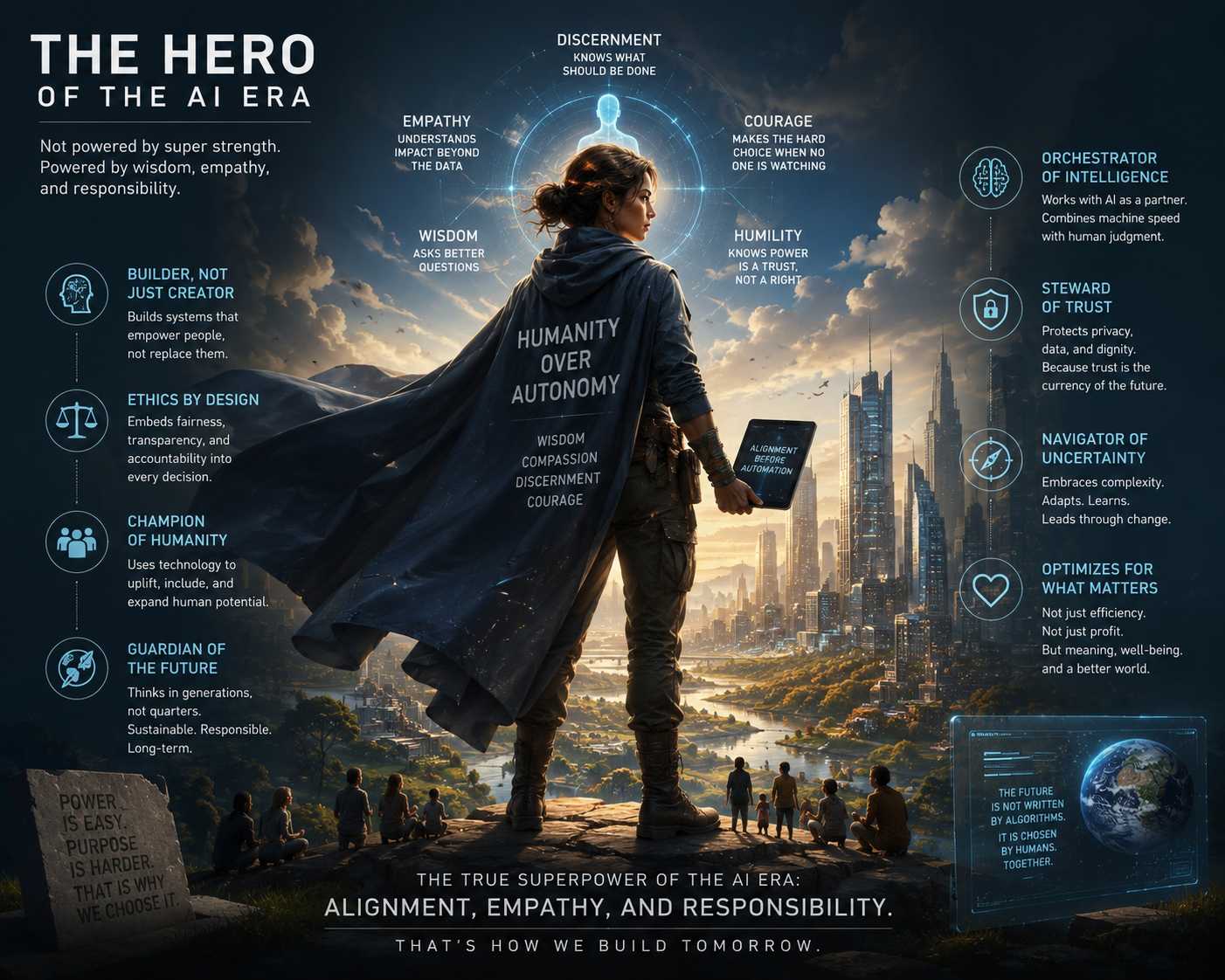
The Hero of the AI Era May Not Wear a Cape
For centuries, heroes were defined by what they could accomplish. The next generation of heroes may instead be defined by what they refuse to sacrifice.
Ethics over efficiency.Judgment over automation.Human dignity over optimization.
The hero of the AI era may not be the person who builds the most powerful model. It may be the leader who ensures powerful systems remain profoundly human.
The architect who designs AI that expands human capability instead of replacing human purpose. The educator who teaches discernment in an age of infinite information. The policymaker who remembers that progress without principles eventually ceases to be progress.
The Chief AI Officer who understands that deploying AI is not merely a technical responsibility. It is a cultural one.
Perhaps This Is the Myth We Are Writing
Grant Morrison argues that every generation rewrites its mythology. If that's true, then AI will not simply transform business. It will transform how civilization understands responsibility, creativity, judgment, and power.
Perhaps future generations won't judge us by how intelligent our systems became. They will judge us by whether our wisdom evolved as quickly as our technology.
Because every civilization creates the heroes it needs. The Greeks imagined impossible strength. The twentieth century imagined impossible power. Perhaps the twenty-first century must imagine something even more difficult.
A hero capable of wielding powerful intelligence without surrendering human judgment, empathy, and moral responsibility.
That may become the defining myth of our age. And perhaps the real superhero of the AI era won't be artificial at all.
It will be the very human leaders who ensure that, as our machines become more capable of acting, humanity never stops choosing why we act in the first place.
“The measure of an AI-first future will not be how powerful our systems become, but how intentional we remain.”